
Female Hair Loss & Thinning: Symptoms, Causes by Age, and Proven Solutions
Key Points
- 1. Main Causes and Types of Hair Thinning and Hair Loss in Women
Hair thinning in women encompasses a variety of types, primarily FAGA (diffuse alopecia), as well as postpartum alopecia, seborrheic alopecia, traction alopecia, and alopecia areata. Depending on the cause—such as hormonal changes, scalp inflammation, or physical irritation—specific countermeasures are required. - 2. Lifestyle and Environmental Factors, and the Importance of Self-Care
Stress, an unbalanced diet or excessive dieting, smoking and alcohol consumption, UV exposure, and frequent use of hair dye or perms can lead to poor blood circulation and damage to the scalp. It is important to improve nutritional balance, protect against UV rays, and maintain a consistent routine of proper hair care and stress management. - 3. Characteristics by Age Group and Life Stage, and Guidelines for Seeking Medical Care
The causes and symptoms vary depending on age (from your 20s to 50s and beyond), as well as during pregnancy, childbirth, and menopause. If you experience persistent hair loss or scalp abnormalities, it is recommended that you consult a dermatologist or a clinic specializing in hair loss to receive professional support, such as topical medications, scalp treatments, and lifestyle guidance.
In today’s world, where more women are entering the workforce, the number of women worldwide struggling with thinning hair and hair loss—just like men—is rapidly increasing due to stress from household chores and childcare, as well as exposure to UV rays.
It is estimated that nearly 10 million women in Japan suffer from thinning hair or hair loss, meaning that one in ten women has concerns about their hair.
In this article, we explore the types and causes of thinning hair and hair loss—a topic often referred to as “a woman’s crowning glory”—and examine possible treatments.
- Types of Hair Thinning in Women
- Diffuse alopecia
- Postpartum hair loss
- Seborrheic alopecia
- Traction alopecia
- Alopecia areata
- What causes temporary hair thinning and hair loss in women?
- Stress
- Unbalanced diet
- Excessive dieting
- Tobacco and alcohol
- Damage caused by ultraviolet rays
- Damage caused by hair care products
- Symptoms of Hair Loss and How to Identify Them
- Number of hairs lost
- The shape of the hair follicle
- Hair thickness
- Signs of hair loss that appear on your hair and scalp
- Characteristics of Hair Loss by Age and Life Stage, and Countermeasures
- Hair loss in women in their 20s
- Hair loss in women in their 30s
- Hair loss due to pregnancy and childbirth (postpartum alopecia)
- Hair loss in women in their 40s
- Hair loss in women in their 50s and older
- Hair loss due to menopause
- Treatment and Counseling Options at Medical Facilities
- Which department should I visit?
- The difference between general dermatology and specialized clinics
- Guidelines and timing for medical consultations
- Main treatments available at medical facilities
- Conclusion
Types of Hair Thinning in Women
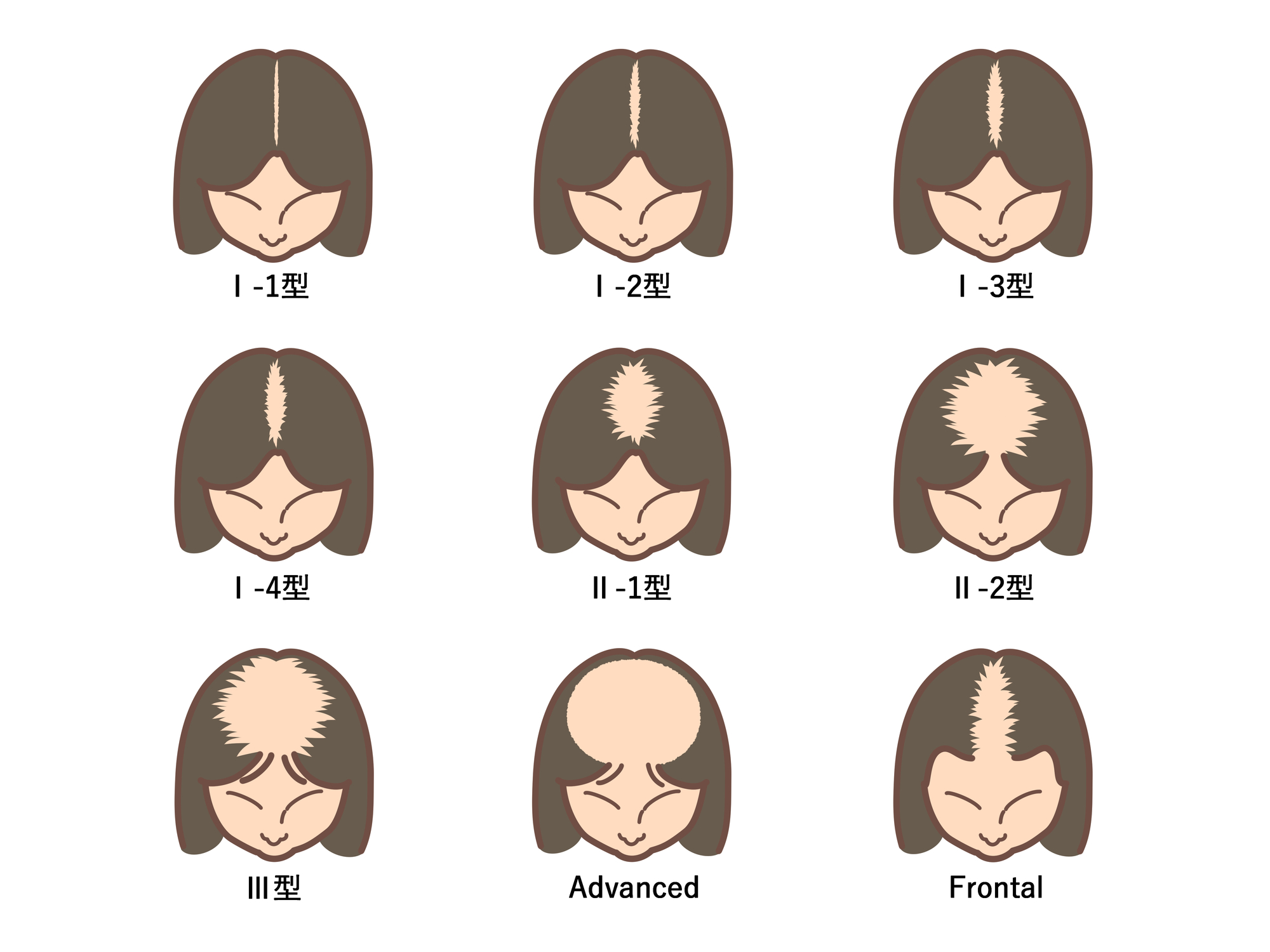
Female pattern hair loss (FAGA) is caused by the harmful male hormone “dihydrotestosterone” (DHT).
DHT is produced when 5α-reductase combines with the male hormone “testosterone.”
FAGA symptoms can be categorized into the nine stages shown in the illustration above, according to the Hamilton-Norwood scale.
FAGA symptoms vary from person to person.
Hair loss progresses starting from the areas most susceptible to the effects of dihydrotestosterone.
What kinds of hair loss symptoms do women experience?
Diffuse alopecia
Diffuse hair loss, also known as FAGA, refers to the gradual thinning of hair that occurs around the time of menopause or after menopause.
As estrogen levels decline during menopause—when ovarian function ceases—hair loss increases due to the influence of the small amounts of male hormones that were previously secreted.
Therefore, unlike male pattern baldness (AGA), hair loss does not progress rapidly; instead, thinning becomes gradually more noticeable with age, and the overall volume of hair on the scalp decreases.
Because of these characteristics specific to women, it is referred to as “diffuse alopecia.”
“Diffuse” is a term you may not be familiar with, but it means “spreading across the entire area,” and in this context, it refers to the condition spreading across the entire scalp.
Postpartum hair loss
Although temporary hair loss can occur after childbirth, most cases are postpartum alopecia.
Generally, hair growth returns to normal naturally within about 6 months to a year after childbirth.
Unlike Male pattern boldness (AGA), a key characteristic of postpartum alopecia is that the edges of the bald patches are not clearly defined.
The following article provides a detailed explanation of the causes of postpartum alopecia and ways to address it.
Seborrheic alopecia
This condition occurs when an imbalance in hormone levels or other factors causes excessive sebum production, which clogs the pores. This leads to an overgrowth of the scalp’s natural bacteria around the pores, causing inflammation of the hair follicles and resulting in hair loss.
People with seborrheic alopecia account for less than 1% of all those suffering from hair loss.
Cause
Seborrheic dermatitis is generally considered to be primarily caused by hormonal factors, and it occurs when seborrheic alopecia becomes severe.
However, nutritional imbalances and excessive stress are major contributing factors to seborrheic alopecia.
Given that it occurs relatively frequently among adolescents, it cannot be ruled out that emotional instability during this developmental stage may also be a trigger.
Countermeasures
Until the scalp inflammation and excess sebum production subside, gently remove sebum using a mild shampoo and maintain the balance of the scalp’s natural flora.
Make a point of eating foods rich in B vitamins, such as spinach, seafood, legumes, and eggs.
Switch to a diet centered on vegetables high in dietary fiber, such as potatoes, seaweed, and mushrooms, and avoid fatty meats, nuts, and snack foods.
It is best to avoid strong irritants like tobacco, alcohol, and coffee, as well as foods that are very spicy, salty, or sweet.
It is also important to engage in moderate exercise to relieve stress and to refresh yourself through activities like hiking.
If you experience severe itching or pain, seek immediate diagnosis from a dermatologist and receive topical antifungal or antihistamine treatments.
Even if absolutely necessary, limit your use to steroid medications (at the “Weak” level—the mildest of the five-tier intensity scale—or the “Mild” level, which is one step above).
Traction alopecia
This is a form of hair loss that occurs when someone wears their hair tied back in styles such as a ponytail or a bun for an extended period of time, causing the hair at the hairline and parting to gradually thin. It can occur in children as well as adults, regardless of age.
Cause
When you tie your hair up, the force pulling on it exceeds the hair’s natural tensile strength, causing the hair follicles to shrink and the hair-producing cells to stop functioning, eventually leading to a lack of new hair growth.
Hair extensions add extra weight to your natural hair, placing significant strain on both your hair and scalp.
Hair straighteners also pull on the hair.
Rough brushing also puts strain on your hair and scalp.
Measures
- Get a short haircut
- When tying your hair, tie it loosely
- Minimize the time spent styling my hair
Alopecia areata
One day, out of the blue, you might discover a patch of hair loss about the size of a coin. Since there were no warning signs or symptoms, it can be quite a shock.
If the progression stops, it usually heals on its own, but in severe cases, the bald patches may spread or multiple patches may appear.
Some people are more prone to this condition, so even if it improves, it may recur.
In terms of age, one-quarter of cases occur in people aged 15 or younger, and the condition is generally more common in children. Unlike “diffuse alopecia,” in which hair thins out across the entire scalp, “alopecia areata” involves hair loss limited to specific areas.
The causes of alopecia areata and ways to treat it are explained in detail in the following article.
What causes temporary hair thinning and hair loss in women?
Regardless of gender, the three main factors contributing to thinning hair and hair loss are “hormones,” “environment,” and “lifestyle.”
While it has long been believed that genetic factors (constitution) play a significant role in thinning hair and hair loss, it is now understood that they are not the primary cause of thinning hair and hair loss in women.
Stress
Stress puts the autonomic nervous system—which regulates blood flow—under strain, causing blood vessels to constrict and impairing blood circulation.
This stress-induced poor circulation prevents sufficient nutrients from reaching the hair follicles, which negatively impacts hair growth.
In addition, it can lead to various health issues such as decreased organ function, insomnia, and excessive adrenaline secretion, all of which contribute to accelerated aging throughout the body.
To consciously manage stress, engaging in sports or pursuing hobbies is an effective approach.
Unbalanced diet
A lack of nutrients or an unbalanced diet can slow hair growth, so a well-balanced diet is essential for healthy hair.
Hair is composed of 95% keratin, a protein formed by the bonding of 18 different amino acids.
Keratin levels decrease with age.
However, this is not solely due to aging; smoking, alcohol, and an irregular diet can also contribute to this decline.
Not limited to keratin, a lack of nutrients or an unbalanced diet can slow hair growth.
A well-balanced diet is essential for healthy hair growth.
In particular, to revitalize your hair and scalp, we recommend supplementing your daily diet with B vitamins and zinc.
Excessive dieting
Drastically reducing your food intake or resorting to extreme “bad diets” like fasting is bad for your hair—and for your body as a whole.
Nutrients are prioritized for vital organs such as the brain and heart, which are essential for sustaining life.
When your hair doesn’t receive enough nutrients, not only does the quality of your hair—including its body, strength, and shine—deteriorate, but it can also lead to thinning hair and hair loss.
Therefore, avoid extreme dietary restrictions and commit to a healthy diet while incorporating exercise.
Tobacco and alcohol
The nicotine in tobacco acts on the central nervous system, triggering the release of dopamine—a neurotransmitter that boosts mood—which stimulates the brain and provides a momentary sense of relief.
This activates the sympathetic nervous system, causing blood vessels to constrict, muscles to tense, and the feeling of euphoria to intensify.
If this state persists frequently, the constriction of blood vessels leads to a lack of nutrients reaching the scalp, which hinders hair growth.
That is why smoking is a cause of thinning hair and hair loss.
Drinking alcohol places a heavy burden on the liver, which is responsible for breaking down alcohol.
Since the liver also regulates nutrients circulating in the bloodstream, when it becomes exhausted, it disrupts the balance of cholesterol levels in the blood.
This increased burden on the liver affects the nutrients and blood supply to the scalp, which in turn has a negative impact on hair growth.
Damage caused by ultraviolet rays
While many women are careful about protecting their skin from UV rays, few seem to pay much attention to their hair.
However, it’s surprisingly little known that when hair follicles are damaged by UV rays, the scalp can become sunburned or dry, leading to hair loss.
Be sure to protect the top of your head—which is exposed to direct sunlight—from UV rays when you’re out and about by wearing a hat or using a parasol.
Damage caused by hair care products
In addition to environmental factors like UV rays, which are known to affect hair, irritation caused by the hair care products you use daily can also be a contributing factor.
Even if you use a product with the best of intentions, its ingredients or how you apply it could have the opposite effect, so caution is necessary.
Hair damage is also exacerbated by coloring, perms, styling products that aren’t fully washed out, and the heat from hair dryers.
While perms, coloring, and hair straighteners are essential for many women, they can easily damage hair, so it’s important to be mindful of how you use and choose these products.
Symptoms of Hair Loss and How to Identify Them
Many people worry, “Is my hair loss normal or abnormal?” Here, we’ll explain the key factors for distinguishing between normal and abnormal hair loss, including the number of hairs shed, the shape of the hair follicles, hair thickness, and signs that appear on the scalp and hair.
Number of hairs lost
Generally speaking, losing 50 to 100 hairs a day is a natural occurrence, even in healthy individuals. Depending on the season, this number may increase to around 150. However, you should be concerned if you consistently lose more than 200 hairs a day or if you notice a significant increase in hair loss. Try checking for yourself by looking at the amount of hair in the drain or on your pillow.
The shape of the hair follicle
If the base of a shed hair (the hair root) is black and rounded, it is normal hair shedding. On the other hand, if the hair root lacks a sheath, is thin and pointed, or the root itself is not visible, it may indicate abnormal hair loss caused by a dry scalp, nutritional deficiencies, or inflammation.
Hair thickness
Unless you naturally have fine hair, you should be concerned if your hair suddenly becomes thinner or you notice a loss of body and strength. Hair can become thinner due to aging, stress, or FAGA. If the hair you shed is fine and short, this is also a sign of a problem.
Signs of hair loss that appear on your hair and scalp
If you experience any of the following symptoms, you may be experiencing increased hair loss or a deterioration in the condition of your scalp.
- Your scalp feels greasy or extremely dry
- I’ve been getting more dandruff and itching
- My hair has started to look more frizzy and split-ended
- My parting and crown are becoming more noticeable
- My hair has lost volume and has thinned out overall
If you experience several of these symptoms, you may be experiencing hair loss. If you find it difficult to assess the situation on your own or are feeling particularly anxious, consider consulting a specialist.
Characteristics of Hair Loss by Age and Life Stage, and Countermeasures
Hair loss in women varies in terms of characteristics, causes, and appropriate solutions depending on age and life events.
Here, we explain the trends in hair loss and recommend solutions for each life stage, including women in their 20s, 30s, 40s, and 50s and beyond, as well as during pregnancy, childbirth, and menopause.
Hair loss in women in their 20s
In your 20s, the main causes include stress from new environments such as starting a job or moving, scalp damage from hair coloring and perms, and extreme dieting.
In particular, stress and disruptions to your daily routine can affect your hormonal balance, which may lead to increased hair loss.
Key points for preparation
- Make an effort to maintain a regular daily routine
- Avoid extreme dieting and focus on eating a balanced diet
- Limit the frequency of coloring and perms, and choose hair care products that are gentle on the scalp
- Incorporate hobbies and exercise to relieve stress
Hair loss in women in their 30s
Your 30s are a time when life events such as balancing work and family life, as well as pregnancy and childbirth, often occur simultaneously. A decline in physical stamina and changes in your living environment can also contribute to hair loss.
Key points for preparation
- Get plenty of quality sleep and take care of your health
- Hair loss during and after pregnancy is often temporary, so don’t panic—just keep up with your hair care routine.
- Incorporate self-care practices such as scalp massages and hair growth treatments
- Don’t shoulder the burden of housework and work alone; talk to those around you
Hair loss due to pregnancy and childbirth (postpartum alopecia)
After pregnancy and childbirth, sudden changes in hormone levels can lead to “postpartum hair loss,” a condition characterized by temporary increased hair shedding. In most cases, hair growth returns to normal naturally within six months to a year after childbirth.
Key points for preparation
- Make sure to eat a nutritionally balanced diet and get plenty of rest
- Don’t worry too much about hair loss; just wait for it to recover naturally
- If you’re concerned, consider using postpartum hair growth products or scalp care treatments
Hair loss in women in their 40s
As women enter their 40s, the secretion of the female hormone estrogen decreases due to aging and menopause, making hair more prone to becoming thinner and losing volume. Changes in hair texture, such as gray hair and frizz, also begin to become noticeable.
Key points for preparation
- Considering anti-aging shampoos and hair growth products
- Actively consume foods that support female hormones, such as soy products
- If you’re concerned about dryness or itching on your scalp, be sure to incorporate moisturizing care into your routine
- Make a conscious effort to refresh your mind and body to avoid letting stress build up
Hair loss in women in their 50s and older
Many women in their 50s go through menopause, and the sudden changes in hormone balance can lead to noticeable hair loss and a deterioration in hair quality. They are also more prone to dry scalp, dandruff, and itching.
Key points for preparation
- Make scalp massages, hair growth products, and moisturizing care part of your routine
- When going out, protect yourself from UV rays by wearing a hat or using a parasol
- It is also important to review your lifestyle habits, such as diet, sleep, and exercise
- If your hair loss or scalp problems do not improve, consult a specialist
Hair loss due to menopause
During menopause, a decrease in female hormones can lead to noticeable hair loss and a loss of volume. Low mood and stress can also exacerbate hair loss.
Key points for preparation
- Reviewing lifestyle habits such as diet, sleep, exercise, and stress management
- Consumption of compounds similar to female hormones, such as soy isoflavones
- Using scalp massages and anti-aging products
- Make time for relaxation and hobbies
Treatment and Counseling Options at Medical Facilities
If you are experiencing severe hair loss or thinning, or if your condition does not improve despite ongoing self-care, it is important to seek a professional diagnosis and treatment at a medical facility as soon as possible.
Here, we will introduce the main types of medical facilities that treat female hair loss, guidelines for when to seek medical attention, and the types of treatments available at these facilities.
Which department should I visit?
The appropriate medical department varies depending on the cause and symptoms of hair loss. If you’re unsure, it’s best to start by visiting a dermatologist, who can refer you to a specialized clinic or another department if necessary.
- Dermatology: Itchy scalp, dandruff, inflammation, and thinning hair
- Gynecology: Hormonal imbalances following pregnancy and childbirth, or due to irregular menstrual cycles
- Internal medicine: Experiencing other health issues besides hair loss
- Psychosomatic medicine and Psychiatry: Severe stress, psychological trauma, and alopecia areata Psychosomatic Medicine and Psychiatry
- Clinic specializing in hair loss treatment: Chronic hair loss and thinning hair that doesn’t improve with self-care
The difference between general dermatology and specialized clinics
General dermatology clinics offer diagnosis and treatment for a wide range of scalp and hair issues. If your symptoms are mild, or if you are experiencing scalp inflammation, eczema, or dandruff, you should first consult a dermatologist.
On the other hand, if you are concerned about chronic hair loss or thinning, such as FAGA (female androgenetic alopecia) or diffuse alopecia, visiting a clinic specializing in hair loss treatment is another option. At these specialized clinics, you can undergo more detailed examinations, receive personalized treatment plans tailored to your specific symptoms, and benefit from professional counseling.
Guidelines and timing for medical consultations
If any of the following apply, consider consulting a healthcare provider.
- Losing more than 100 hairs a day over an extended period
- My parting and crown have suddenly become more noticeable
- Itching, redness, dandruff, or inflammation of the scalp
- I haven’t seen any improvement even though I’ve been continuing my self-care routine
- Accompanied by mental stress or physical discomfort
Main treatments available at medical facilities
At medical facilities, the following treatments are provided depending on the symptoms and cause.
- Topical medication (hair growth treatment)
A topical minoxidil solution for women (1% concentration) has been approved in Japan and is used to treat female androgenetic alopecia (FAGA) and diffuse hair loss. Be sure to use it correctly under the guidance of a pharmacist or doctor. - Oral medication
There are no oral medications covered by insurance for the treatment of female hair loss. Please note that medications intended for men (such as finasteride and dutasteride) should not be used by women. - Supplements and nutritional guidance
They also provide supplements containing nutrients essential for hair growth, such as iron and zinc, as well as dietary advice. - Treatment to improve scalp health
If you have scalp inflammation, dandruff, or seborrheic dermatitis, treatment typically involves anti-inflammatory medications or topical treatments. - Counseling and advice on lifestyle habits
You can also receive advice from experts on stress management and making changes to your lifestyle. - Wig and hairstyle suggestions
If needed, we can also provide consultations on wigs and hairstyles designed to add volume.
Conclusion
There are several types of hair thinning and hair loss in women, including FAGA (diffuse alopecia), postpartum hair loss, seborrheic alopecia, traction alopecia, and alopecia areata. The causes vary widely and include hormonal changes, scalp inflammation, and physical irritation. In particular, around the time of menopause, after childbirth, and during perimenopause, a decline in female hormones can lead to a general loss of volume and temporary hair loss.
Additionally, lifestyle and environmental factors—such as stress, an unbalanced diet, excessive dieting, smoking and alcohol consumption, UV exposure, frequent coloring or perming, and tight hairstyles—can worsen thinning hair by causing poor scalp circulation and damage. Therefore, it is important to thoroughly practice self-care, including reviewing your nutritional balance, protecting against UV rays, using gentle hair care products, and managing sleep and stress.
While the causes and solutions vary depending on age and life stage, if you experience persistent scalp issues such as increased hair loss, itching, or redness, it is advisable to consult a dermatologist or a clinic specializing in hair loss treatment as soon as possible. Receiving professional support—including topical medications, scalp treatments, and lifestyle guidance—can provide peace of mind.
If you are concerned about thinning hair or hair loss, please consult a clinic specializing in AGA or FAGA treatment as soon as possible to avoid worrying alone and accumulating stress.
Frequently Asked Questions
- What are the different types of hair thinning and hair loss in women?
There are several types of hair loss in women, including FAGA (diffuse alopecia), postpartum alopecia, seborrheic alopecia, traction alopecia, and alopecia areata. Since the causes and progression differ for each type, it is important to take measures tailored to the specific condition.
- What are the main causes of thinning hair and hair loss in women?
The main causes include hormonal imbalances, scalp inflammation, and physical irritation from tight hairstyles. In particular, fluctuations in female hormones and a deterioration in scalp health are believed to be associated with the onset and progression of conditions such as female androgenetic alopecia (FAGA) and postpartum hair loss.
- Do lifestyle habits and the environment affect thinning hair and hair loss?
These factors can have an impact. Stress, an unbalanced diet or excessive dieting, smoking and alcohol consumption, UV exposure, and frequent hair coloring or perming can lead to poor blood circulation and damage to the scalp, which can exacerbate thinning hair and hair loss.
- What are some things I can do on my own to address thinning hair and hair loss?
It is important to adopt self-care practices such as reviewing your diet to ensure it is nutritionally balanced, protecting your skin from UV rays, practicing proper hair care that does not strain the scalp, and getting enough sleep and managing stress. Improving these lifestyle habits is a fundamental step toward maintaining a healthy scalp environment.
- When should I see a healthcare provider?
Regardless of age—whether in your 20s, 30s, 40s, 50s, or beyond—if you experience persistent hair loss or scalp issues such as itching or redness, it is recommended that you consult a dermatologist or a clinic specializing in hair loss. Since the causes can vary depending on life stages such as pregnancy, childbirth, and menopause, it is important to seek professional support, including topical medications, scalp treatments, and lifestyle guidance.