
Free AGA Consultation: What to Expect, Benefits, and Why You Should Get One

Many clinics specializing in AGA offer free consultations. Did you know that the first crucial step in AGA treatment actually begins right at the free consultation stage?
We’ve seen patients who, due to communication breakdowns during the free consultation, fail to achieve the desired results from their AGA treatment and end up giving up on their treatment partway through.
In this article, we’ll discuss the importance of consultations as a factor in choosing an AGA-specialized clinic, as well as the key points you should check during your consultation.
We’ve summarized the symptoms, causes, and prevention methods for hair loss caused by androgenetic alopecia in the following article.
If you are concerned about AGA, we recommend consulting a specialist as soon as possible. At Osaka AGA Kato Clinic, we will work closely with you to address your concerns and recommend the most appropriate treatment plan. Click here to book an appointment via LINE.
- The Process from Booking a Free AGA Consultation to Your Appointment
- General steps for a free consultation
- What kinds of questions do doctors and counselors ask?
- 3 Key Points to Check During a Free AGA Consultation
- Ask about treatment options
- Check the duration of treatment
- Check the clinic’s fee schedule
- Could it be AGA? Early Symptoms and the Importance of Seeking Early Counseling
- What is AGA (Androgenetic Alopecia)?
- Early signs that are easy to notice
- Why early counseling is important
- Common Concerns About AGA Counseling and How to Address them
- Is counseling really free?
- For those who feel embarrassed or afraid to seek advice
- “What if it isn’t AGA?”
- “I’m worried they might try to push me into expensive treatments.”
- “I’m concerned about the side effects of treatment.”
- The Future Brought About by AGA Counseling
- My anxiety is gone, and I feel lighter
- You’ll gain clarity on your situation and the best course of action
- Get a Free AGA Consultation at Multiple Clinics
- Get a consultation at a clinic with a proven track record
- Conclusion
The Process from Booking a Free AGA Consultation to Your Appointment
 A free AGA consultation is an important first step for anyone concerned about their hair. Understanding the entire process—from making an appointment to the consultation and receiving a treatment plan—will help you feel more at ease during your visit.
General steps for a free consultation
An AGA consultation proceeds as follows:
- Apply via our website, by phone, or on LINE
- Come to the clinic and fill out the medical history form
- Counseling (Concerns about Thinning Hair, etc.)
- Checking the Condition of the Scalp
- Explanation of Treatment Plan and Costs
First, make an appointment for your preferred date and time via our website, by phone, or through LINE. On the day of your visit, after completing a brief registration process at the front desk, you will be asked to fill out a medical questionnaire. Here, we will ask not only about your hair concerns but also about your medical history and lifestyle habits.
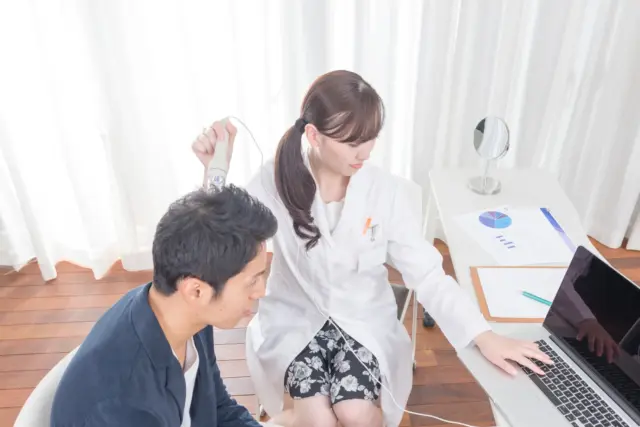
After completing the questionnaire, you will proceed to a one-on-one consultation with a specialized counselor or physician. During this consultation, we will listen carefully to your specific concerns and then examine the condition of your scalp through visual inspection and using a microscope.
A microscope is a device that magnifies the scalp up to 200 times, allowing for a detailed diagnosis of the condition of hair follicles and pores that are invisible to the naked eye.
Afterward, we’ll provide a basic explanation of AGA, our assessment of your current condition, possible treatment options, and an explanation of the costs involved. If you have any questions or concerns, you’re welcome to ask them at this time.
At this stage, there is absolutely no obligation to proceed with treatment, and it’s perfectly fine to simply say, “I’ll think it over,” and leave.
What kinds of questions do doctors and counselors ask?
During your consultation, the doctor or counselor will ask you several questions to make an accurate diagnosis and recommend the best course of treatment. Knowing what questions to expect in advance will help you prepare mentally.
First, as part of the basic information, you’ll be asked in detail about when you first noticed changes in your hair and which areas are of particular concern to you.
- “When did you first notice that your hairline was receding?”
- “How many months ago did you first start noticing thinning on the top of your head?”
Family history is also an important factor. Whether your father, grandfather, or maternal grandfather has thinning hair can serve as a clue in determining the genetic component of AGA.
You may also be asked detailed questions about your daily lifestyle habits. Factors such as a balanced diet, sleep patterns, stress from work or personal relationships, and smoking and drinking habits can all influence the progression of hair loss.
It is also common to be asked whether you have ever tried self-care measures such as hair growth products or supplements, and how effective they were. Your medical history and any medications you are currently taking will also be thoroughly reviewed.
This is because certain medical conditions and medications can cause hair loss, and this information is necessary to avoid interactions with AGA treatments.
Please understand that these questions are by no means intended to pry into your personal life or criticize you; they are necessary to accurately assess your condition and determine the most appropriate course of action.
3 Key Points to Check During a Free AGA Consultation

What should I focus on asking during a free consultation at a clinic specializing in AGA?
Ask about treatment options
Compared to general dermatology clinics, clinics specializing in AGA offer a wider variety of treatment options. In other words, they have a broader range of approaches to address the various causes and stages of hair loss.
However, at reputable clinics specializing in AGA, doctors assess each patient’s physical condition and prescribe medications such as “Propecia” or “Dutasteride”—which place minimal strain on both the patient’s body and wallet—to proceed with treatment.
If a combination therapy doesn’t produce results, it’s common to switch to an alternative treatment method, such as a customized regimen.
Just because there are many treatment options available, be wary of clinics that recommend customized regimens or growth factor injections from the outset without providing a sound basis for doing so.
When attending a consultation, be sure to also check the treatment methods offered by clinics specializing in AGA.
Check the duration of treatment
When treating patients with either a single-drug or combination therapy regimen, it is standard practice to continue treatment for at least six months while carefully adjusting the drug concentration. The duration of treatment varies depending on the patient’s preferences and the clinic’s treatment methods.
Be wary of clinics that make irresponsible promises like, “You’ll see results in just one month.”
We recommend asking your doctor or counselor how long each treatment method is expected to take.
Check the clinic’s fee schedule
Treatment at clinics specializing in AGA is generally considered “private medical care,” which is not covered by insurance. Reputable AGA clinics have simple, easy-to-understand pricing structures that minimize the financial burden on patients.
Please don’t hesitate to ask questions about costs. Asking questions to alleviate financial concerns is important.
- “What is the breakdown of the initial and ongoing costs?”
- “Is this covered by insurance?”
- “Are there any options, such as installment payments?”
- “Is there a refund policy if the product doesn’t work?”
At unscrupulous clinics with limited technical expertise, staff will recommend treatments that are ineffective for the patient’s hair loss and pressure them into taking out high-interest medical loans.
At reputable clinics specializing in AGA, a doctor will assess the patient’s hair loss and provide a detailed explanation of the costs required to improve the condition. Be sure to ask the counselor for a thorough explanation of the treatment plan and associated costs.
Please see the article below for a general overview of AGA treatment costs and information on the clinical trial program that can help reduce treatment expenses.
Could it be AGA? Early Symptoms and the Importance of Seeking Early Counseling
When you notice changes in your hair, it can be difficult to determine whether it’s AGA or just temporary hair loss. Here, we’ll explain everything from the basics of AGA to its early symptoms and the benefits of seeking early consultation.
What is AGA (Androgenetic Alopecia)?
AGA (androgenetic alopecia) is a progressive form of hair loss caused by DHT (dihydrotestosterone), a type of male hormone, acting on the hair follicles. It is not simply “age-related hair thinning,” but a medically defined condition.
It is a common condition that is said to affect about 30 percent of Japanese men, and it is by no means rare.
Early signs that are easy to notice
The early signs of AGA can often be noticed in your daily life. The most obvious sign is “increased hair loss.” Take a moment to observe whether you’ve noticed any changes, such as more hair getting caught in your fingers while shampooing, noticeable hair on your pillow, or hair clogs in the drain more easily than before.
Next, “thinning hair” is another important sign. Hair that was once thick and healthy gradually becomes thinner and weaker, losing its body and volume.
A receding M-shaped hairline and thinning on the crown are also signs that should not be overlooked.
However, even if you notice these signs, it does not necessarily mean you have AGA. Temporary hair loss can also be caused by other factors, such as stress, nutritional deficiencies, or hormonal imbalances.
Therefore, it is important not to self-diagnose but to seek a professional evaluation.
Why early counseling is important
The most important characteristic of AGA is that it is “progressive.” In other words, if left untreated, the condition will gradually worsen.
Maintaining the current condition or treating the condition in its early stages is far easier and more cost-effective than restoring hair that has already been lost.
The greatest benefit of seeking early counseling is that you can receive an accurate diagnosis. A medical professional can determine whether it is truly AGA or temporary hair loss caused by other factors.
Furthermore, in the early stages, relatively mild treatments can be expected to be effective. While advanced cases may require expensive treatments, in many early-stage cases, oral and topical medications alone are sufficient to achieve effective results.
Even from a financial perspective, seeking early consultation offers significant benefits.
Common Concerns About AGA Counseling and How to Address them

Even if you’re thinking about getting an AGA consultation, many people may find themselves unable to take that first step due to various concerns and questions. Here, we’ll address some common concerns and offer ways to resolve them.
Is counseling really free?
Many people worry that even if a clinic advertises a “free consultation,” there might actually be some cost involved. To put it simply, at many AGA specialty clinics—including the Osaka AGA Kato Clinic—the initial consultation and basic visual examination are completely free.
If you decide not to proceed with treatment, you will not be charged anything.
However, if you decide to begin treatment after your counseling session, there will be some costs involved. First, you may need to undergo blood tests for a more detailed diagnosis.
This generally costs between 5,000 and 10,000 yen.
However, if you decide to begin treatment after your counseling session, there will be some costs involved. First, you may need to undergo blood tests for a more detailed diagnosis.
This generally costs between 5,000 and 10,000 yen.
It is important to note that, in all cases, a detailed breakdown of costs will be provided before you agree to treatment. In addition, there are multiple options available in the treatment plan, and we can offer proposals tailored to your budget.
We will never pressure you into signing up for an expensive plan.
For those who feel embarrassed or afraid to seek advice
It’s natural to feel embarrassed about discussing hair loss or to worry about being seen entering a clinic by someone you know. Many people feel the same way at first. However, clinics specializing in AGA take these psychological concerns fully into account.
First, out of consideration for patient privacy, many clinics generally provide care in completely private rooms. Some clinics have implemented a system where patients are escorted from the waiting room to the examination room without coming into contact with other patients.
From check-in to your consultation, every step of the process is handled by our specialized staff. They interact daily with many people facing similar concerns and fully understand how you feel. They will never judge or look down on you.
Rather, they are partners who support you for taking this first step and work with you to find the best solution.
In addition, online medical consultations have become increasingly widespread in recent years. There are many services that allow patients to consult with a doctor via video call from the comfort of their own homes, and an increasing number of clinics—including the Osaka AGA Kato Clinic—now offer the option to complete the entire process, from the initial consultation onward, online.
“What if it isn’t AGA?”
Some people may think, “Even if I go through the trouble of getting a consultation, isn’t it a waste of time if I’m told I don’t have AGA?”
This is a complete misunderstanding. The consultation and diagnostic process are of great value regardless of the outcome.
If you are diagnosed as not having AGA, this will not only put your mind at ease but also serve as an important opportunity to investigate other possible causes. There are many different causes of thinning hair and hair loss.
There are various possible causes, including lifestyle factors such as stress, lack of sleep, and an unbalanced diet; endocrine disorders such as hypothyroidism; or side effects from certain medications.
Specialists in AGA are knowledgeable about these possibilities and will conduct appropriate tests or refer you to another specialist as needed. A diagnosis of “not AGA” can be considered the first step toward finding a more appropriate treatment.
“I’m worried they might try to push me into expensive treatments.”
Many people worry that when they visit a clinic, they’ll be pressured into undergoing expensive treatments. It’s true that there may be some clinics that use aggressive sales tactics.
However, reputable clinics specializing in AGA strive to provide recommendations tailored to each patient’s individual condition and needs.
At Osaka AGA Kato Clinic, we offer a wide range of options, from mild treatments aimed at prevention or maintaining your current condition to comprehensive approaches designed to actively promote hair regrowth. For each plan, we’ll explain the expected results along with a clear breakdown of costs.
We will never pressure you into a treatment that does not suit the severity of your condition or your budget. You will not be asked to make an immediate decision on the spot; instead, you’ll have plenty of time to consult with your family or compare our clinic with others.
It’s perfectly fine to say, “I’ll think about it,” and leave.
AGA treatments range across a wide price spectrum, from basic plans costing a few thousand yen per month to plans combining more advanced treatments that cost tens of thousands of yen per month.
“I’m concerned about the side effects of treatment.”
Many people are concerned about the side effects of AGA treatment. In particular, a wide variety of information circulates online, which can cause anxiety.
While the possibility of side effects is not zero, it is important to understand the reality of the situation correctly.
Finasteride and minoxidil are widely used as common AGA treatments. Finasteride is taken orally and prevents the progression of AGA by inhibiting the action of male hormones.
As for side effects, cases of decreased sexual function (such as reduced libido or erectile dysfunction) have been reported in very rare instances; however, the incidence rate is low—around 1%—and in most cases, symptoms resolve once the medication is discontinued.
On the other hand, minoxidil is primarily used as a topical treatment and is effective in promoting blood circulation and hair regrowth. Reported side effects include scalp irritation, itching, and redness; however, the incidence rate for these is also low, and in most cases, they are mild and temporary.
It is important that a doctor thoroughly assess your health before you begin using these medications. Through blood tests and other examinations, the doctor will check your liver function and other health indicators to determine whether it is safe for you to use the medication.
Furthermore, even after treatment begins, the doctor will monitor you for any signs of side effects through regular checkups and examinations, and adjust your treatment plan as necessary.
The Future Brought About by AGA Counseling

Undergoing an AGA consultation means more than just a medical consultation. It is the first step toward freedom from the worries of hair loss and will serve as an opportunity to discover a new version of yourself.
Here, we’ll discuss the positive changes that a consultation can bring.
My anxiety is gone, and I feel lighter
Concerns about thinning hair are not just a cosmetic issue; they also take a heavy emotional toll. Vague anxieties—such as “Will this keep getting worse?” or “How do others see me?”—cast a shadow over every aspect of daily life.
The first benefit of seeking counseling is receiving a “clear answer.” You’ll gain a medical assessment that clarifies whether your condition is actually androgenetic alopecia (AGA), a temporary symptom caused by other factors, and how far it has progressed.
When vague anxiety is replaced by concrete facts, the psychological burden is likely to be greatly reduced.
Another major benefit is being freed from the sense of helplessness that comes from not knowing what to do. By learning effective coping strategies and creating a concrete action plan, you can regain a sense of control over the situation.
Even if things don’t return to exactly how they were before, simply knowing that there are ways to halt the progression or achieve partial improvement can help you feel more positive.
You’ll gain clarity on your situation and the best course of action
Another major benefit of counseling is that it allows you to gain an accurate understanding of your situation and learn about specific options based on that understanding. Much of the information found online or in magazines is general in nature and may not be the best fit for your individual circumstances.
First, a diagnosis by a specialist will clarify the cause and severity of your hair loss. Is it an M-shaped receding hairline, thinning on the crown, or both? Is it in the early stages, or has it progressed significantly? Based on this assessment, the most effective treatment approach will be recommended.
Thanks to advances in medical technology, treatment options for AGA are increasing year by year. You can choose the method best suited to your condition and preferences from a variety of options, including oral medications, topical treatments, injection therapy, light therapy, and hair regeneration treatments.
By learning about the expected results, duration, and costs associated with each treatment option, you’ll be able to make an informed decision.
Get a Free AGA Consultation at Multiple Clinics
 To avoid regrets after a free consultation, it is important to “understand the clinic’s unique features (treatment approach).” Communication with the doctor during the consultation stage is also crucial to ensuring you won’t regret your AGA treatment.
We recommend getting free consultations at two (or at most three) clinics, and once you’ve determined the treatment plan and costs that are right for you, you can begin treatment.
Get a consultation at a clinic with a proven track record
I recommend focusing on getting free consultations at AGA specialty clinics that have a good reputation online. Well-established AGA specialty clinics set aside about an hour for each patient’s consultation.
Furthermore, doctors and counselors do not simply give one-sided explanations. It’s fair to say that well-established AGA specialty clinics excel at listening to patients’ concerns about hair loss.
For more details on how to choose an AGA clinic, please refer to the article below.
Conclusion
An AGA consultation is a major step forward for anyone concerned about hair loss. As outlined in this article, a free consultation provides an accurate diagnosis of AGA, suggests treatment options, and offers a transparent explanation of costs.
If you notice early symptoms, seeking advice early is effective and crucial for slowing the progression of hair loss. By attending a consultation, you can alleviate vague anxieties and gain clarity on the best options for you.
If you’ve noticed changes in your hair, taking action early will expand your options for the future. An appropriate diagnosis and treatment by a specialist can be expected to yield more reliable results than self-administered care. Don’t struggle with this alone—we recommend starting with a free consultation.
That first step will lead you toward freedom from hair concerns and the restoration of your confidence.
Frequently Asked Questions
- What kinds of tests are performed during the free AGA consultation?
During a free AGA consultation, the following tests and diagnostic procedures are typically performed:
- Review of detailed symptoms, lifestyle habits, and family history based on the medical history form
- Checking the condition of the scalp and hair through visual inspectionDetailed examination of the scalp using a microscope (to check the condition of the pores, hair thickness, etc.)
- Professional diagnosis and evaluation by a physician or counselor
Blood tests are not typically performed during the free consultation; they are conducted as needed once treatment begins. Even with just these basic tests during the free consultation, you can obtain a professional assessment of your condition.
- Is AGA treatment covered by insurance? What is the approximate cost?
Unfortunately, since AGA is classified as a “symptom” rather than a “disease,” treatment costs are generally not covered by insurance. The estimated costs are as follows.
- Oral medications (such as finasteride): Approximately 5,000 to 15,000 yen per month
- Topical medications (such as minoxidil): Approximately 3,000 to 8,000 yen per month
- Hair Regrowth Injections (such as mesotherapy): Approximately 10,000 to 30,000 yen per session
- Blood tests: Approximately 5,000 to 10,000 yen (required for the initial visit and on a regular basis)
However, pricing structures vary significantly from clinic to clinic. In addition, with the introduction of certain generic drugs in recent years, costs have become more affordable than before. During a free consultation, you’ll receive a treatment plan tailored to your symptoms and budget, along with a detailed breakdown of costs.